
Chargent and Payment Gateways: Key Differences Explained
Digital payment systems can be complex, even for seasoned professionals. One question we hear all the time from Salesforce users is: “How is Chargent different from a payment gateway?”
It’s a good question — and an important one. After all, if your organization is trying to improve cash flow, automate billing, or scale operations across dozens (or hundreds) of locations, understanding how these pieces fit together could mean the difference between struggling with manual workarounds and building a frictionless, scalable payment strategy.
Below, we’ll break down what a payment gateway does, how Chargent fits into the picture, and why the right integration can make all the difference for finance and operations teams using Salesforce.
What Is a Payment Gateway?
A payment gateway is the technology layer responsible for transmitting sensitive payment information from your website, app, or Salesforce environment to the processor that authorizes and settles the transaction. You can think of it as a secure digital courier. When a customer submits a payment, the gateway’s job is to package that data, encrypt it, and deliver it safely to the payment processor — no detours, no delays, and no leaks.
A gateway doesn’t typically manage billing logic, handle recurring payments, or know anything about your customers or business rules. It’s designed to do one job: securely move payment data.
Some examples of well-known gateways include Authorize.net, Stripe, and CyberSource. If your organization is accepting payments online or via card-not-present methods, you’re already relying on a gateway without even realizing it.
But here’s where things can get confusing: Businesses using Salesforce still need a way to connect their payment gateway to their CRM workflows. That’s where Chargent comes in.
What Is Chargent?
Chargent is a Salesforce-native payment solution, which means it’s built entirely on the Salesforce platform and operates seamlessly within your existing Salesforce environment. Chargent integrates with over 30 different payment gateways, including popular options like PayPal, Authorize.net, Stripe, and CyberSource.
Unlike a gateway, Chargent doesn’t handle transaction authorization, but it gives you complete control over when, where, and how those transactions are initiated, tracked, and managed. Instead of logging into an external portal to run charges or fix failed payments, Chargent brings everything into Salesforce, right where your data and workflows already live.
In short: Chargent doesn’t replace your payment gateway — it makes it usable inside Salesforce.
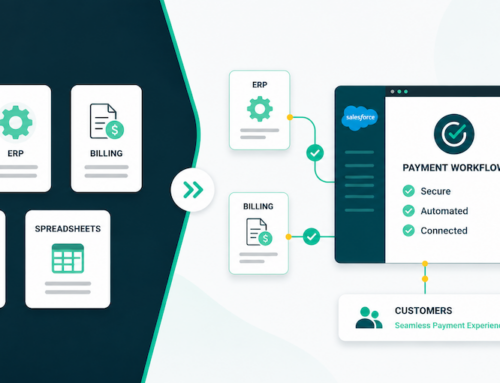
This is especially important for enterprises with large sales teams, multiple departments, or complex workflows. By embedding payment processing into your existing Salesforce org, Chargent helps you go from clunky, disconnected systems to one centralized payment process that works across your entire customer lifecycle.
Why It Matters: The Value of Chargent + Gateway Integration
More than just streamlining workflows, integrating Chargent with your payment gateway can bring operational clarity and speed to an area of business that’s typically fragmented and frustrating. For organizations managing thousands of transactions or operating across multiple teams and tools, the impact is often immediate and measurable.
In fact, some organizations have reported a 5x return on investment after implementing Chargent’s Automated Collections. Others have seen 43% reductions in Days Sales Outstanding (DSO) and 60% recovery rates on failed payments, without manual intervention. Beyond just improving process efficiency, these kinds of results can fundamentally transform cash flow and resource allocation.
Here’s more about how Chargent delivers value:
1. Automate Billing and Reduce Manual Work
Manual billing is time-consuming, error-prone, and unsustainable at scale. With Chargent, finance and operations teams can automate a wide range of billing tasks directly within Salesforce:
- Set up automated recurring payments for subscriptions, installment plans, or even use cases like recurring giving, which is common among nonprofits.
- Schedule future-dated charges for delayed billing cycles.
- Automatically retry failed transactions using smart retry logic.
These automations eliminate the need for spreadsheets, calendar reminders, or switching between systems. Your team spends less time chasing payments and more time focusing on strategy and service.
Whether you’re processing a thousand payments a week or a few complex transactions per client, Chargent removes the friction of manual intervention to help you accelerate cash flow and reduce the administrative load.
2. Simplify Compliance and Secure Payment Data
Using Chargent means sensitive payment information never needs to live inside your Salesforce org. It’s encrypted, tokenized, and routed through your payment gateway, which already follows strict PCI and security protocols. At the same time, you’re leveraging Salesforce’s own user permissions and logging structure. This dual-layer approach keeps things secure while helping your internal teams maintain control over who can do what.
3. Improve Cash Flow With Better AR and Collections
Collections should be strategic, not reactive. When your payment tools are embedded inside Salesforce, you gain access to real-time financial insights and automated workflows that support healthier cash flow. Automated collections have been shown to deliver up to 87% faster processing speeds, 79% improvements in team efficiency, and significant reductions in DSO.
With Chargent, you can:
- Trigger alerts when payments are overdue or fail.
- Automatically retry payment collection at chosen intervals.
- Automatically send customized reminders or dunning emails based on payment status.
- Route tasks or escalations to the appropriate team, right within Salesforce.
No more waiting until end-of-month reports to see what’s past due. Chargent empowers your teams with proactive, automated tools to improve days sales outstanding (DSO), reduce write-offs, and recover revenue before it slips through the cracks. Integrating capabilities like smart payment routing adds further optimization by sending each transaction through the most efficient path available.
4. Scale Across Teams, Brands, or Locations
Chargent’s payment gateway integration services support enterprise structures with many moving parts. If your company has different regions, departments, or service lines, you can create unique rules for each one. Different gateways, different automation triggers, different approval steps — it’s all configurable. Chargent doesn’t force a one-size-fits-all model; instead, it helps you standardize what matters while giving flexibility to local teams.
So… What’s the Real Difference?
Let’s break it down in a simple table:
| Feature | Payment Gateway | Chargent |
| Securely routes payment data | ✅ | ⛔ |
| Built into Salesforce | ⛔ | ✅ |
| Handles billing logic | ⛔ | ✅ |
| Supports recurring payments | ✅ | ✅ |
| Automates failed payment retries | ❌ | ✅ |
| PCI compliance support | ✅ | ✅ |
| Integrates with multiple gateways | ❌ | ✅ |
In essence, a payment gateway moves data. Chargent gives you control over the entire payment process, integrated into Salesforce.
Make Your Payments Work Harder
If you’re already using Salesforce and a payment gateway, but still managing invoices and payments manually — or worse, outside the CRM — it’s time to close the loop.
Download our free Automated Collections checklist to learn how to:
- Automate collections
- Reduce payment failures
- Improve retention and cash flow
This simple guide will help you assess where Chargent fits into your current payment stack and how to get started fast.
A Powerful Partnership To Improve Your Billing Process
No matter how innovative your product or service may be, your business still relies on consistent, well-managed payments to succeed. The systems behind that process need to be both dependable and flexible enough to support change as you grow.
Payment gateways offer security and transaction routing, but they operate independently of your customer data and business logic. Chargent brings those elements together by embedding payments into Salesforce. That integration gives your teams the visibility and control they need to manage payments more strategically.
If your business depends on Salesforce and needs a smarter way to handle transactions, try Chargent for free and see how it fits into your current workflow.