Payment Pain Point: Solving Disconnected Systems and Reconciliation Headaches
Failed payments are a major cause of financial friction, but they aren’t the only cause. Disparate systems that require too much attention to match, reconcile, and report on also play a role.
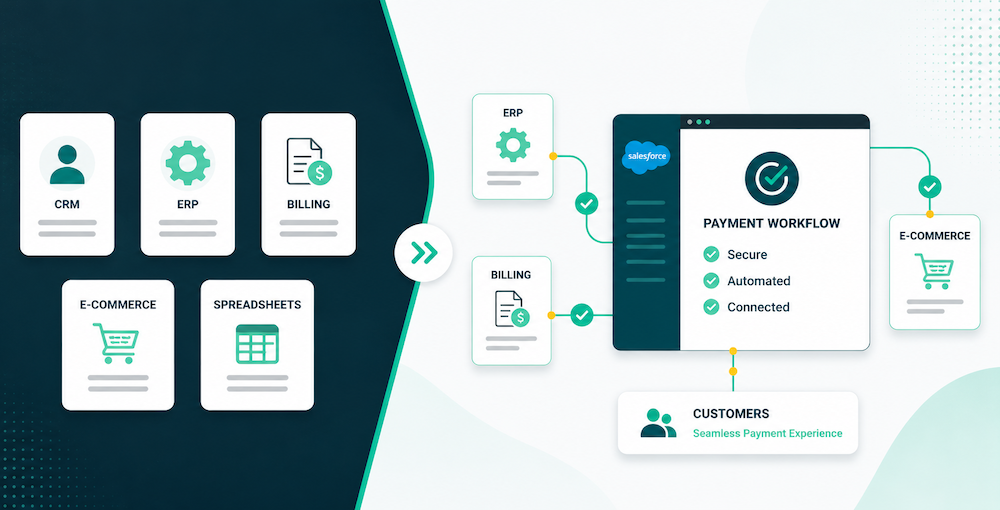
When customer data, payment activity, billing details, ERP records, and finance workflows live in separate systems, teams lose visibility. Sales may not know whether an invoice has been paid. Finance may not trust CRM status fields. Operations may depend on exports, spreadsheets, and manual matching just to understand what revenue has actually been collected.
That kind of disconnect is more common than it should be. MuleSoft reported that organizations now use an average of 991 applications, and Salesforce’s summary of the 2025 MuleSoft Connectivity Benchmark emphasized that connected data, systems, and processes are no longer optional. As the application landscape expands, the cost of disconnected workflows rises with it.
Why disconnected payment and finance systems create so much drag
When systems do not communicate well (or at all,) reconciliation becomes an arduous, manual process.
Teams may need to batch and sync files between CRM, ERP, gateway, e-commerce, and billing platforms. Someone has to compare records, identify mismatches, confirm settlements, and figure out whether an invoice status is current or stale. In many environments, that work still happens in spreadsheets or through repeated exports and imports. And in the more advanced scenarios where teams have written code to automate reconciliation processes, that code often needs to be maintained when other tools in the stack are updated.
That is not just inefficient. It erodes confidence in the numbers. Deloitte notes that reliance on spreadsheets and disconnected systems increases manual effort and error risk. Trintech makes a similar point in finance-specific terms, noting that accountants and finance professionals often face a heavy burden when reconciling data from many internal and external systems and payment methods.
Once that burden grows, downstream issues follow: slower reconciliation, delayed revenue visibility, more audit stress, and less confidence across teams about what has actually been paid.
The real cost is the loss of a single source of truth
This is the central business issue. Without connected systems, there is no reliable single source of truth.
Sales sees pipeline and customer activity in one system. Finance sees transaction data in another. E-commerce or billing may sit somewhere else entirely. Every handoff creates a chance for a mismatch. Every delay in syncing creates a window where one team is working from outdated information.
In complex environments, this gets worse, not better. EY recently noted that disconnected ERP, terminal, trading, POS, and billing systems create reconciliation gaps, mismatches, and billing errors, and that better integration can unlock real-time visibility and shorten billing cycles by two to seven days. While that example comes from a specific industry context, the underlying lesson applies broadly: disconnected systems slow cash visibility and create unnecessary reconciliation work.
Why manual reconciliation does not scale
Manual reconciliation often survives because it feels controllable. Teams know the spreadsheet. They know the export process. They know who checks which numbers. But as transaction volume grows and system count expands, that model starts to crack.
More systems mean more formats. More transactions mean more exceptions. More revenue channels mean more opportunities for a mismatch between what the customer did, what the payment processor recorded, what the ERP posted, and what the CRM shows.
This is why integration has become a finance issue, not just an IT issue. If disconnected systems force finance to spend time matching records instead of acting on them, the business is paying a hidden operational tax every month.
The Chargent approach: bring payment visibility closer to the customer record
Chargent addresses this at the workflow level.
By processing payments directly in Salesforce, where the customer record already lives, Chargent helps businesses gain immediate visibility into revenue collection in the same environment where sales, service, and account activity already happen. Instead of pushing payment events off into a disconnected operational silo, teams can work with more current payment information inside the CRM.
That creates a practical benefit: it becomes easier for teams to know whether money has been collected and what happened in the customer journey around that payment. If any type of reconciliation is still required, the operational gap between customer context and payment context is still smaller and more manageable.
For more complex enterprise environments, the Chargent API provides a pro-code path for connecting external systems, supporting custom data models, and automating payment workflows across the broader tech stack. That matters because many businesses are not working in a simple two-system world. They need flexibility to connect CRM, ERP, ecommerce, and finance processes in a way that fits their architecture rather than forcing another disconnected workaround.
Thought leadership means treating reconciliation as a systems design issue
Too many businesses treat reconciliation headaches as a finance team problem. In reality, they are typically a systems design problem.
Are your payment records and customer records connected closely enough for teams to act confidently?
Do sales and finance see the same payment reality?
Are employees still exporting, batching, and matching files across systems?
Are disconnected tools delaying revenue visibility or increasing error risk?
Those are not just operational cleanup questions. They are strategic questions about how well the business can scale.
The companies that solve reconciliation well are usually the ones that reduce fragmentation first. They bring payment data closer to the systems where customer work is already happening, and they leverage APIs and workflows that connect the rest of the stack more cleanly.
That is how a business moves from manual matching to usable visibility.
Frequently Asked Questions
Why do disconnected systems create reconciliation headaches?
Disconnected systems create reconciliation headaches because payment, billing, CRM, ERP, and e-commerce data live in different places. That forces teams to manually compare records, investigate mismatches, and confirm whether payments have actually been collected.
What causes manual reconciliation in payment operations?
Manual reconciliation usually happens when sales, finance, and operations systems do not sync payment and invoice data automatically. Teams then have to export files, match transactions by hand, and resolve discrepancies across multiple platforms.
How can businesses reduce reconciliation errors?
Businesses can reduce reconciliation errors by bringing payment activity closer to the customer record, improving integrations between systems, and reducing spreadsheet-based or manual matching processes.
Why is a single source of truth important for payments and billing?
A single source of truth helps teams work from the same payment and customer data. That improves visibility, reduces confusion between departments, and makes it easier to track invoice status, collections, and revenue accurately.
How does processing payments in Salesforce help with reconciliation?
Processing payments in Salesforce can improve reconciliation by giving teams payment visibility where customer data already lives. That helps reduce disconnected workflows and makes it easier for sales, service, and finance teams to work from more current information.
How does the Chargent API help connect payment workflows across systems?
The Chargent API gives businesses a pro-code way to connect external systems, support custom data models, and automate payment workflows across ERP, billing, ecommerce, and Salesforce environments.