Payment Pain Point: Taking Control of Recurring Billing and Failed Payments
Recurring revenue is attractive because it promises predictability. But as subscription, membership, and installment models scale, the billing operation behind them often becomes more fragile. Payment schedules vary, customer terms change, cards expire, and failed transactions multiply. What should feel automated starts to depend on manual retries, ad hoc exceptions, and finance teams spending time recovering revenue that should have been collected automatically.
The financial impact is significant. Stripe says failed payments on subscription services cost businesses about 9% of annual revenue. Even small payment-performance improvements can have major revenue impact. Worldpay notes that a 1% drop in authorization rate can translate into millions in lost annual revenue, while a 1% lift on $500 million in annual processing volume can equal $5 million in recovered revenue. Zuora has also reported that 20% to 40% of subscriber churn happens because of payment failure.
Failed payments are not minor transaction issues
This is why failed payments should not be treated as minor transaction issues. A soft decline can delay revenue, create support tickets, interrupt service, and ultimately lead to involuntary churn. Stripe has noted that 25% of lapsed subscriptions are due to payment failures. In many cases, the customer did not choose to leave; the billing process failed to recover them.
Why manual retries do not scale
At lower volumes, businesses can often mask this problem with manual work. Someone exports a list of failed charges, retries cards by hand, updates a spreadsheet, or sends follow-up emails. But manual recovery is not a strategy. It is inconsistent, expensive to maintain, and difficult to optimize. Moss Adams and Baker Tilly describe this clearly in their subscription billing guide: manual workarounds may fill the gap early, but they break down as customer counts grow, terms diversify, and billing scenarios become more complex.
Recurring billing needs flexibility
Recurring billing also becomes harder when the system lacks flexibility. Many organizations are not just managing monthly subscriptions. They are also handling quarterly service plans, annual memberships, installment arrangements, deposits, and customer-specific schedules. When those needs are forced into brittle custom code or disconnected subscription tools, billing complexity turns into process debt.
Automate both billing and recovery
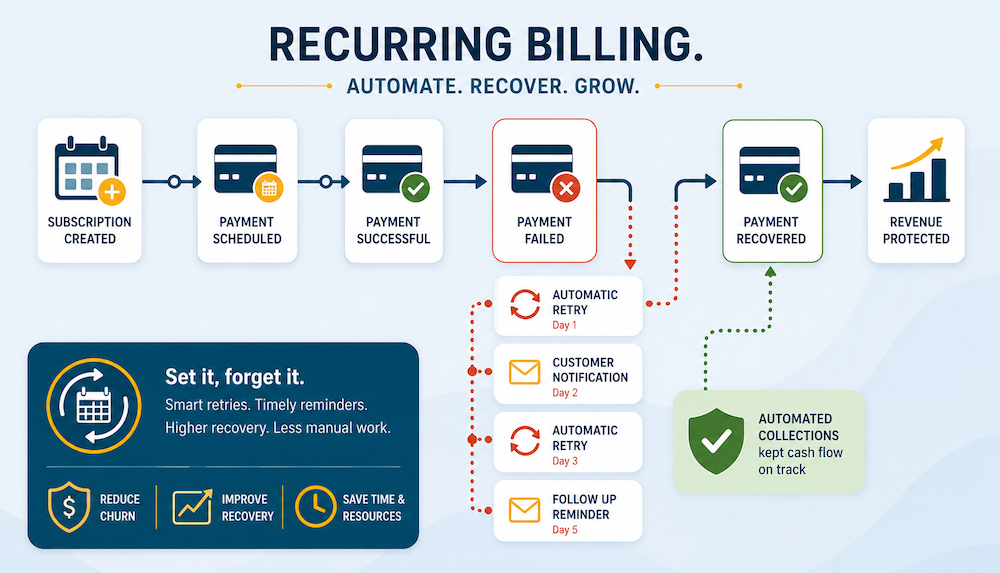
The stronger approach is to automate both billing and recovery. Chargent’s Recurring Billing engine gives Salesforce teams a set-and-forget way to manage subscriptions, installments, memberships, and other recurring payment models with flexible payment frequencies. Instead of relying on custom code or disconnected platforms, businesses can automate recurring charges in the same environment where customer and revenue workflows already live.
To address lost revenue, Automated Collections adds the recovery layer many teams are missing. Failed payments can be retried automatically, customizable dunning emails can be sent without manual intervention, and analytics can show which collection workflows are actually performing. Stripe reports that its revenue recovery tools saved 57% of failed payments and recovered $5.32 billion for users in 2023. The broader lesson is clear: systematic recovery consistently outperforms ad hoc manual follow-up.
Recurring billing is a growth lever
Recurring billing should be treated as a growth lever, not an administrative task. The businesses that scale recurring revenue most effectively are not just the ones that launch subscriptions. They are the ones that build billing and collections processes designed to reduce preventable churn, recover more of the revenue they have already earned, and support growth without adding operational friction every quarter.
Frequently Asked Questions
What is recurring billing?
Recurring billing is a payment model where customers are charged automatically on a scheduled basis, such as monthly, quarterly, annually, or by custom frequency for subscriptions, memberships, or installment plans.
Why do failed payments matter so much in recurring billing?
Failed payments can delay revenue, create extra work for finance teams, and lead to involuntary churn when customers are lost because a payment did not go through.
How can businesses reduce failed payments?
Businesses can reduce failed payments by using automated retry logic, proactive customer notifications, updated payment methods, and analytics to improve their collections process over time.
What is Automated Collections for recurring payments?
Chargent’s Automated Collections is a tool that retries failed payments and sends communications, such as dunning emails with payment request links, without requiring staff to manage these steps manually.
How does recurring billing automation help businesses scale?
Recurring billing automation helps businesses scale by reducing manual billing work, improving payment consistency, and making it easier to manage subscriptions, installments, and memberships at higher volume.
Sources
- Stripe, on failed payments costing subscription businesses about 9% of annual revenue:
https://stripe.com/resources/more/dunning-what-subscription-based-businesses-need-to-know - Recurly Research Metrics Report, on 15% of monthly revenue going uncollected and retention improvements from effective decline management:
https://recurly.com/resources/report/churn-benchmarks/ - Worldpay, on how a 1% drop in authorization rate can translate into millions in lost annual revenue:
https://www.worldpay.com/en/insights/articles/grow-faster-with-fewer-declines - Zuora, on 20% to 40% of subscriber churn happening because of payment failure:
https://www.zuora.com/press-release/businesses-lose-up-to-four-in-ten-customers-due-to-payment-failure/ - Stripe, on 25% of lapsed subscriptions being due to payment failures:
https://stripe.com/blog/how-we-built-it-smart-retries - Recurly Annual Subscription Billing Metrics Report, on involuntary churn benchmarks:
https://recurly.com/research/annual-subscription-billling-metrics-report/ - Stripe, on revenue recovery tools saving 57% of failed payments and recovering $5.32 billion for users in 2023:
https://stripe.com/blog/subscription-business-leaders-are-looking-for-a-better-way-to-combat-churn - Moss Adams and Baker Tilly, on manual subscription billing workarounds failing to scale as billing complexity grows:
https://www.mossadams.com/getmedia/92cc1063-b612-4664-914b-364299536007/360subscriptionbillingguide2025.pdf