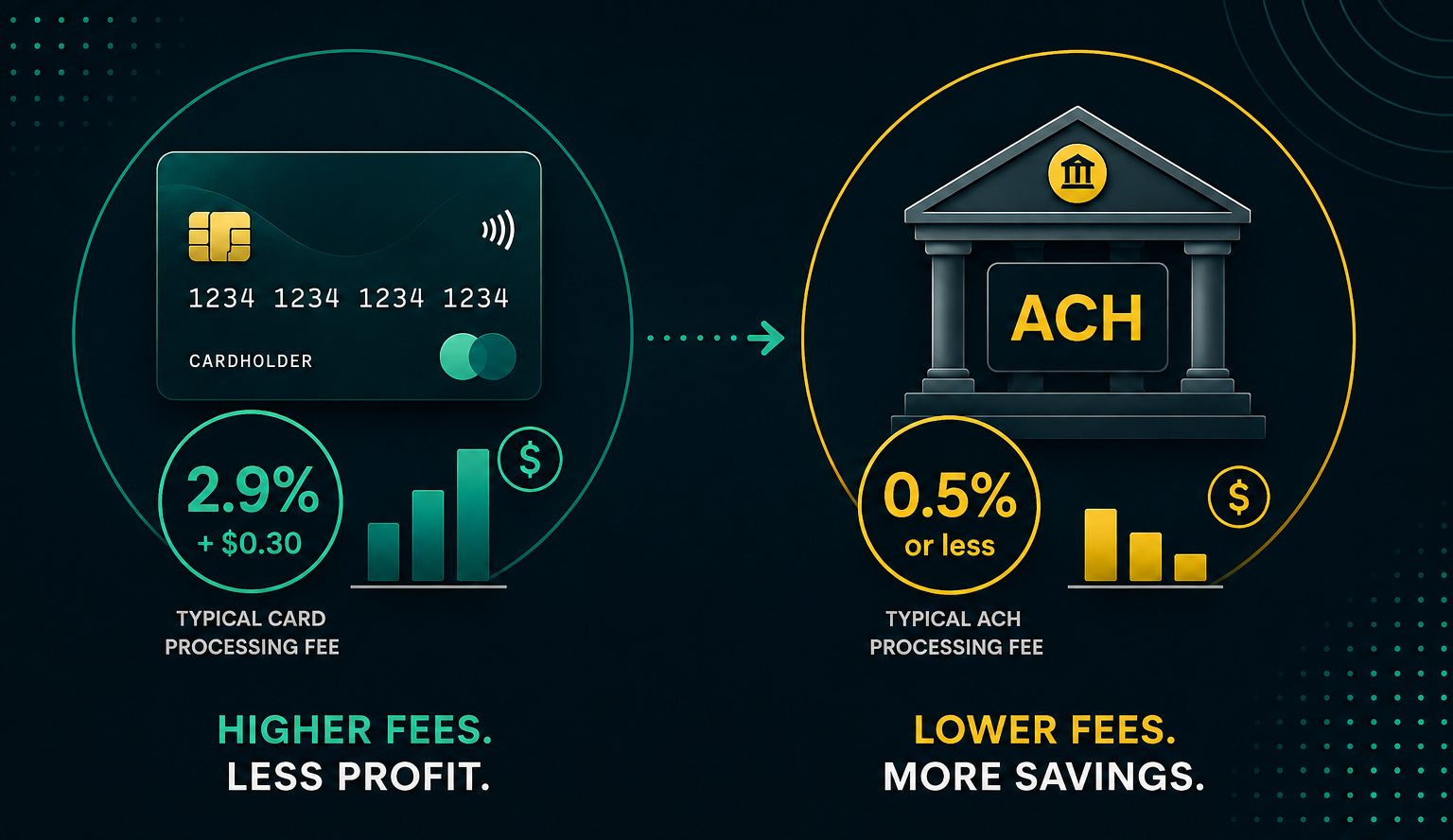
Credit cards are convenient, familiar, and widely accepted. They can also be one of the most expensive ways for a business to collect payment.
For companies that process recurring payments, large invoices, membership dues, professional service fees, or other predictable transactions, Automated Clearing House (ACH) payments can provide a more cost-effective alternative. ACH transfers move money directly between bank accounts, avoiding the percentage-based fees associated with card payments.
Moving customers to ACH takes more than adding a bank payment option to a form. Customers need a clear reason to change a payment method they already know and trust. Your business also needs the right technology, communications, incentives, compliance controls, and measurement plan.
This playbook walks through how to build that program.
Why businesses should encourage ACH payments
Lower payment processing costs
ACH payments are typically much less expensive to process than credit card payments, particularly for larger transactions. Credit card fees are often calculated as a percentage of the transaction, while ACH providers typically charge a flat fee, or a lower percentage with a cap.
The exact savings will depend on your payment gateway, processor, transaction volume, average payment amount, and contract. The Federal Reserve notes that bank-based payments may be less expensive than cards, but businesses should account for gateway fees, processor fees, implementation costs, and other services when calculating the final savings.
Even a modest difference in cost per transaction can produce meaningful savings when applied across thousands of payments.
Fewer interruptions caused by expiring cards
Credit cards have expiration dates. They can also be replaced because of fraud, loss, theft, or a change in card issuer.
Bank accounts do not have a scheduled expiration date. Although customers can close or change their accounts, established customers tend to keep primary bank accounts for long periods. That can make ACH particularly valuable for subscriptions, installment plans, memberships, and other recurring payment programs. Nacha specifically identifies recurring ACH as a way to reduce payment processing costs and payment interruptions associated with expired card information.
Fewer payment disruptions can mean:
- Less involuntary customer churn
- Fewer payment-update requests
- Less time spent retrying failed payments
- More predictable recurring revenue
- A better experience for customers
Strong support for recurring and high-value payments
ACH is well suited for scheduled and recurring transactions between parties that know one another, including bill payments and business-to-business transactions. Because ACH costs tend to be less dependent on the transaction value, the potential savings can become especially attractive for larger invoices.
Greater payment choice for customers
Moving customers toward ACH does not require eliminating cards. The most effective programs give customers a choice while making the financial advantages of ACH clear.
Some customers may still prefer cards for rewards, convenience, fraud protections, or short-term cash-flow management. Others will happily switch when ACH is easy to use and comes with a meaningful benefit.
The goal is to make ACH the most attractive option for the transactions where it makes sense.
Disadvantages of ACH Payments
While ACH payments have many advantages, there are some disadvantages you should be aware of.
Bank account numbers can be verified by various methods (Stripe provides authentication via Stripe Financial Connections or microdeposits, and there are other 3rd party integrations that provide ACH validation for any payment gateway).
However, it is important to understand that ACH transactions are not approved or declined in the same way that credit card transactions are. ACH transactions can go through, and then later be declined for various reasons, similar to a paper check:
- Insufficient funds
- Slower settlement times
- ACH block (security that requires account holders to authorize debits)
- Added compliance requirements (obtaining customer authorization, honoring revocations)
- Account closed (for previously validated accounts)
For these reasons, you should understand the capabilities of your ACH provider to notify you of ACH returns. Some providers do send electronic notifications that can support automated workflows, while others will require manual work.
A step-by-step ACH adoption playbook
Step 1: Establish your baseline and savings target
Begin by understanding how customers currently pay you.
Collect at least three to six months of payment data around key transaction details:
- Total card transaction volume
- Number of card transactions
- Average payment amount
- Current card processing costs
- Current ACH volume and fees
- Percentage of recurring payments made by card
- Card decline and payment-retry rates
- Revenue lost because recurring payments could not be recovered
- Payment abandonment rates by channel
Then calculate your approximate savings opportunity. In a nutshell, that equation should look something like this:
Qty of payments moved to ACH in a year × average savings per successful payment = projected annual savings
Subtract any incentive costs, implementation expenses, return fees, and additional gateway charges to estimate the program’s net value.
Set a realistic adoption target. For example, a company might aim to move 15% of eligible recurring card payments to ACH during the first 90 days. Starting with a defined customer segment makes the results easier to evaluate.
Step 2: Configure ACH with your payment gateway
Before promoting ACH, work with your payment gateway or processor to confirm that the complete payment flow is ready.
Review the following questions with your provider:
Enablement:
- Is ACH enabled on your production merchant account?
- Does the gateway support both consumer and business bank accounts?
- Are one-time and recurring ACH debits supported?
- Can bank accounts be tokenized for future payments?
- What are the transaction fees, monthly fees, return fees, and verification fees?
- Is pricing capped for larger transactions?
- Is bank account validation available?
Limitations:
- Are there per-transaction or daily processing limits?
- How long does settlement typically take?
- How are returns, insufficient-funds events, and account closures reported?
- Are refunds supported through the same workflow?
- What is the maximum amount allowed for ACH debits?
- Are all 50 U.S. states and Washington, D.C. supported?
- Are U.S. territories supported when relevant to your business?
- Are any industries, transaction types, or account categories restricted?
The ACH Network itself reaches U.S. bank and credit union accounts, but gateway features and merchant eligibility can vary. Confirm coverage based on your gateway account rather than assuming every implementation works the same way.
Run test transactions before launch. Your testing should include successful payments, invalid account information, insufficient funds, returns, cancellations, and refunds.
Step 3: Build authorization, validation, and return management into the process
ACH payments require proper customer authorization. The authorization should clearly explain the amount, timing, frequency, and method for revoking permission.
For consumer accounts, businesses must be able to provide the customer with a copy of the authorization and produce proof of it when requested. Nacha also emphasizes that ACH authorizations should use clear, understandable terms and meet all applicable legal requirements.
Work with your gateway, bank, legal team, and payment provider to determine the authorization language and recordkeeping requirements for your specific transactions.
Bank account validation should also be part of the enrollment process. Account validation can help confirm that an account is open and capable of receiving transactions before the first payment is attempted.
Finally, define how your team will handle:
- Insufficient funds
- Closed or invalid accounts
- Unauthorized-payment claims
- Customer revocations
- Duplicate payments
- Delayed returns
- Updates to recurring payment methods
ACH can reduce certain types of payment failure, but it does not eliminate them. A clear exception-management process is essential.
Step 4: Identify the customers most likely to switch
Avoid sending the same message to every customer at once.
Start with customers who have the strongest reason to choose ACH, such as:
- Customers making large payments
- Subscription or membership customers
- Customers enrolled in recurring billing
- Customers who have experienced an expired-card failure
- B2B customers paying invoices
- Long-term customers with an established relationship
- Customers already paying by check (yup, those still exist!)
You can also prioritize customers based on potential savings. Moving one $10,000 monthly invoice to ACH may deliver more value than converting dozens of small transactions.
Create a pilot audience large enough to produce meaningful data, but small enough that your team can respond quickly to questions or technical issues.
Step 5: Make ACH easy to select and complete
Customer communications will have limited impact when the ACH experience is difficult to find or complete.
Review every relevant payment channel, including:
- Online checkout
- Customer portals
- Payment links
- Digital invoices
- Recurring-payment enrollment
- Renewal forms
- Call-center payment tools
- Mobile payment experiences
Present ACH prominently rather than hiding it beneath an “other payment methods” link. Use customer-friendly terms such as Pay from a bank account while also identifying the method as ACH where appropriate.
Keep the form as simple as your compliance and gateway requirements allow. Explain what information customers need and when the payment will appear in their account.
Useful help text might include:
Pay from your bank account and avoid card processing fees. ACH payments are a secure, reliable option for one-time and recurring payments.
After enrollment, send a confirmation that identifies the bank account in a masked format, the payment amount, the payment date, and for recurring or subscriptions payments, the payment schedule.
Step 6: Launch an incentive campaign
Convenience alone may not persuade customers to change a payment method that already works for them. A one-time incentive can give them a clear reason to act now.
Possible offers include:
- An account credit
- A percentage discount with a reasonable maximum
- A bonus month or service upgrade
- A donation to a designated nonprofit
- Entry into a customer giveaway, where legally permitted
Choose an incentive that your projected processing savings can recover within an acceptable period.
For example, spending $10 today to convert a long-term recurring customer makes sense when the change is expected to save more than $10 over the life of the relationship.
Sample ACH campaign email
Subject: Switch to bank payments and receive a $10 credit
Preview text: Update your payment method to ACH for a more reliable way to pay.
Hi [First Name],
You can now pay [Company Name] directly from your bank account.
ACH bank payments offer a simple, reliable option for recurring payments, with no card expiration dates to interrupt your service.
Switch your payment method to ACH by [date], and we’ll apply a one-time $10 credit to your account.
CTA: Switch to ACH
It only takes a few minutes. Once your bank account is securely connected, future payments can be processed automatically according to your existing schedule.
Thank you,
[Company Name]
Sample website banner
Get a $10 credit when you switch to ACH.
Pay securely from your bank account and reduce the chance of interruptions caused by expired cards.
Switch payment method
Consider running a sequence rather than sending one announcement. A typical campaign could include an initial email, a reminder one week later, and a final message shortly before the offer expires.
Step 7: Test surcharging on a limited group of credit card payments
Once ACH is easy to use, card surcharging can create an additional reason for eligible customers to switch.
Begin with a controlled pilot. Choose one business unit, payment channel, customer segment, or transaction category. Do not roll it out across every payment immediately.
Before starting, confirm that your program complies with applicable laws, card-brand requirements, and your acquirer’s rules. Visa permits surcharging on eligible credit card transactions in most U.S. jurisdictions, but it requires advance notice to the acquirer, clear disclosures, and limits on the surcharge amount. Note that Visa debit and prepaid cards cannot be surcharged. Mastercard also restricts surcharging to credit cards and requires advance notice and customer disclosures. State and federal requirements continue to apply.
The regulatory landscape around surcharging is complex, and doing it wrong could result in unhappy customers and hefty fees or penalties to your business.. Chargent has partnered with InterPayments to handle the surcharging fee calculations and compliance for you. It’s a set and forget feature that empowers your business to recover lost revenue the moment you turn it on.
Sample surcharge announcement email
Subject: An update to credit card payments
Preview text: Learn about an upcoming change and how to continue paying without an added fee.
Hi [First Name],
The cost of processing credit card payments continues to affect the price of providing our products and services.
Beginning [date], eligible credit card payments will include a processing surcharge. This allows us to address the cost of accepting credit cards without raising prices for every customer.
You can avoid the surcharge by paying directly from your bank account through ACH.
CTA: Switch to ACH
ACH is available for both one-time and recurring payments. Customers who switch by [date] will also receive a one-time $10 account credit.
Thank you for your understanding,
[Company Name]
Sample payment-form help text
A surcharge applies to eligible credit card payments. Select Bank Account (ACH) to pay without the credit card surcharge.
The fee should be disclosed before the customer submits payment and shown clearly on the receipt. Card-brand rules require prominent, accurate communication about the surcharge.
Step 8: Measure the pilot closely
Compare pilot results with your baseline. Review:
- ACH adoption rate
- Credit card conversion rate
- Overall payment completion rate
- Checkout or payment abandonment
- Processing cost per successful transaction
- Recurring-payment failure rate
- Customer-support burden related to surcharging or ACH payments
- Incentive cost
- Processing savings
- Estimated incentive payback period
Pay special attention to overall payment completion. A rise in ACH adoption is valuable only when the broader payment experience remains healthy.
Review customer feedback as well as quantitative data. Confusing copy, poor form placement, or a difficult bank-account verification process may prevent adoption even when customers are open to ACH.
Step 9: Refine the experience before expanding
Use the pilot results to improve:
- Incentive size and duration
- Email subject lines and calls to action
- Payment-form layout or instructions
- Surcharge disclosures
- Customer-support scripts
- Account-verification steps
- Mobile usability
- Return and retry workflows
Consider testing different messages. Cost savings, reliability, and uninterrupted service will motivate both B2B and B2C customers. Determining what works best in achieving that impact should be part of your testing
Continue offering a clear payment choice. The experience should encourage ACH without making customers feel trapped or surprised.
Step 10: Expand surcharging and ACH promotion gradually
Once the pilot shows that surcharging is not materially harming payment completion or customer retention, expand it in stages.
A gradual rollout might proceed by:
- Adding another customer segment
- Expanding to another payment channel
- Including additional eligible transaction types
- Extending the program to other business units
- Applying surcharging to all eligible credit card payments
Continue monitoring performance after each expansion. Changes in customer mix, transaction value, state requirements, card-brand rules, or payment technology can affect results.
ACH adoption should also become part of your ongoing customer lifecycle. Promote it during:
- New-customer onboarding
- Recurring-payment enrollment
- Contract renewal
- Card-expiration outreach
- Failed-payment recovery
- Invoice delivery
- Customer portal visits
Over time, ACH should become a standard payment option rather than a temporary campaign.
A practical 90-day rollout
A well-managed program can follow this schedule:
Days 1 through 30: Review payment data, confirm gateway fees and functionality, establish authorization procedures, configure validation, and test ACH transactions.
Days 31 through 60: Update payment forms, launch the customer incentive, begin email and website promotion, and establish reporting dashboards.
Days 61 through 90: Introduce surcharging to a limited group of eligible credit card payments, measure abandonment and ACH adoption, refine the experience, and prepare for a broader rollout.
The specific timeline will depend on your payment provider, legal review, technical resources, and customer sentiment.
Make ACH adoption easier inside Salesforce
A project like this has many moving parts, so a cohesive, integrated setup is key in keeping it organized and on track.
Chargent is built 100% on the Salesforce platform, so your team doesn’t need to spend time and effort reconciling payment data separately. We offer direct integrations to Stripe, PayPal, and 30+ more payment gateways, and can automate both ACH validation and surcharging right in your Salesforce org.
In other words, we have you covered for some of the vital technical needs of a successful ACH adoption project..
Moving customers from credit cards to ACH will not happen overnight. With the right experience and incentives, however, every converted payment can help lower processing costs, improve recurring-payment reliability, and protect more of the revenue your business has already earned.
Frequently Asked Questions
1. How can a business encourage customers to pay by ACH?
Make ACH easy to find and simple to use, then give customers a clear reason to switch. Promote the lower risk of payment interruptions, offer a one-time incentive, and explain that ACH can help customers avoid eligible credit card surcharges.
2. Are ACH payments cheaper to process than credit card payments?
ACH payments are typically much less expensive than credit card payments, especially for larger or recurring transactions. Actual costs vary by payment gateway, processor, transaction size, return fees, and merchant agreement, so businesses should confirm their full ACH pricing before launching a campaign.
3. Why is ACH a good option for recurring payments?
Bank accounts do not have scheduled expiration dates, which reduces payment interruptions caused by expired or replaced cards. ACH can help businesses improve recurring-payment reliability, reduce failed-payment recovery work, and create more predictable cash flow.
4. Should businesses add a surcharge to encourage ACH adoption?
A card surcharge can encourage customers to choose ACH, but businesses should begin with a limited pilot. Measure payment abandonment, conversion rates, customer complaints, and ACH adoption before expanding the surcharge to more eligible credit card transactions. Businesses should also confirm all applicable legal, card-brand, and processor requirements.
5. How should a business measure the success of an ACH adoption campaign?
Track ACH adoption, payment completion, processing cost per transaction, ACH return rates, recurring-payment failures, incentive costs, customer-support contacts, and payment abandonment. The strongest programs reduce processing costs while maintaining a smooth customer payment experience.