Salesforce is ushering in a new era with Agentforce Revenue Management (previously known as Revenue Cloud), its powerful replacement for Salesforce CPQ and Billing. As businesses migrate from legacy managed packages to Salesforce’s newer, native revenue management architecture, many teams are asking the same practical question:
How do we connect our payment gateways, especially complex gateways like Cybersource, to this new recurring billing engine without introducing custom development, brittle integrations, or disconnected payment processes?
For organizations that rely on recurring revenue, this is not a small implementation detail. A billing system is only as effective as its ability to collect payment. Quotes, orders, invoices, payment schedules, and recurring billing automation all need a secure, reliable way to connect to the customer’s saved payment method and the merchant’s preferred gateway.
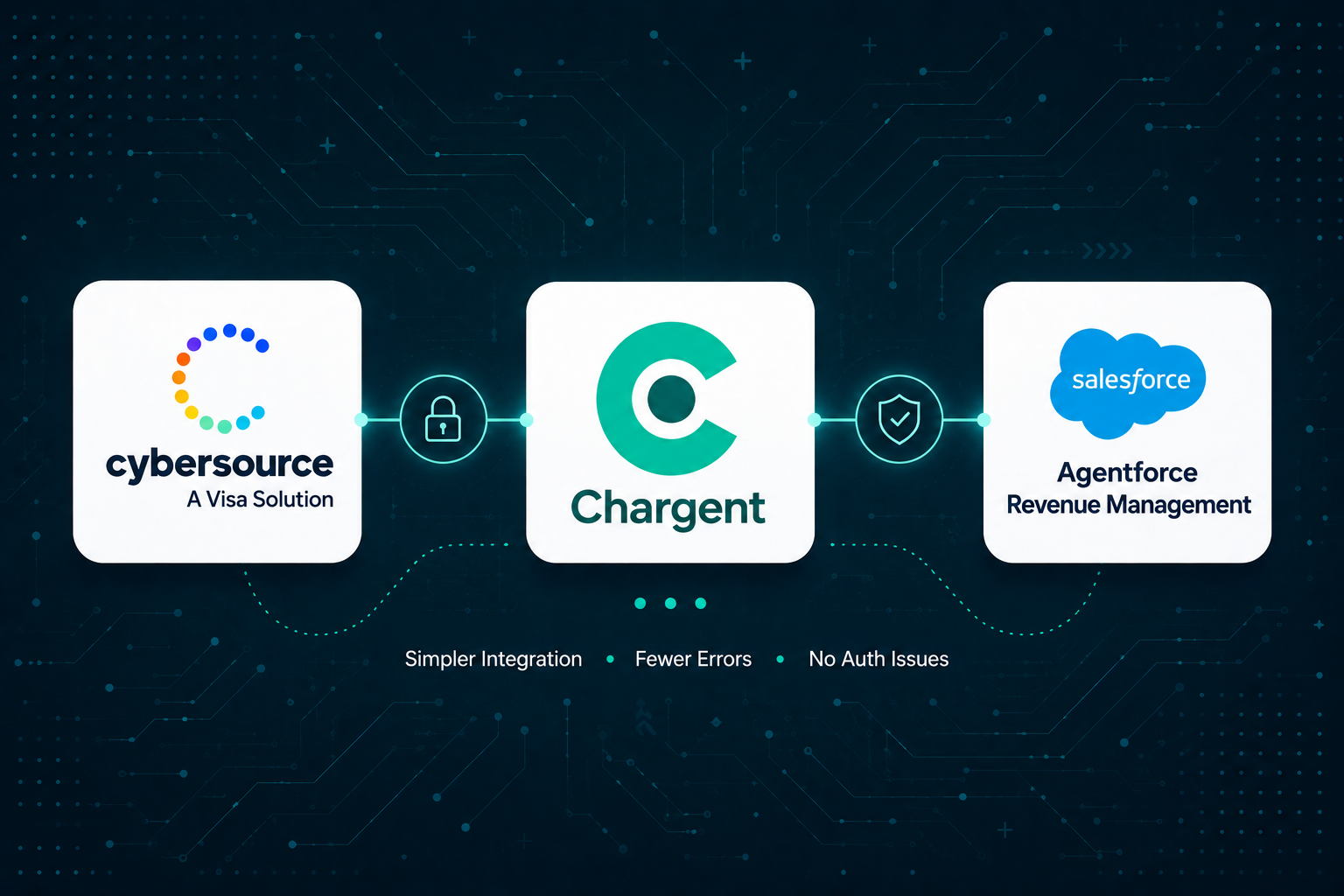
Chargent’s enhanced Salesforce Connector addresses this by providing deep, native integration for Salesforce Revenue Cloud Billing, while solving one of the biggest gateway challenges in the new ecosystem: Cybersource’s new P12 certificate authentication.
The Cybersource Challenge, Solved
Cybersource has introduced a new, more complex authentication method using P12 certificates. For many Salesforce customers and implementation teams, this change has created a significant technical hurdle.
In some cases, payment flows that previously worked were suddenly more difficult to maintain. Standard integrations began running into authentication issues. Teams that expected to focus on Agentforce Revenue Management implementation found themselves spending time on gateway-specific authentication requirements instead.
That creates a frustrating situation. The business wants to modernize its revenue lifecycle in Salesforce. Finance wants recurring billing to run smoothly. IT wants to avoid fragile custom code. Operations wants fewer manual payment exceptions. But gateway authentication becomes a blocker right at the point where payment automation should be accelerating the business.
Our team has engineered a solution that handles the new Cybersource authentication requirements behind the scenes, so Salesforce teams can keep their focus where it belongs: building efficient revenue processes, collecting payments, and improving the customer experience.
In simple terms, Chargent captures what the user or system is trying to do, such as tokenize, authorize, capture, or refund. It then performs the necessary gateway-side work through Chargent, including the complex Cybersource authentication steps, and passes the transaction through Salesforce’s native payment architecture.
Why Native Salesforce Objects Matter
One of the biggest benefits of this enhancement is that it supports Agentforce Revenue Management using standard Salesforce objects across the payment lifecycle.
That matters for both technical and business users.
For technical teams, native objects reduce the need for custom data models, one-off mapping logic, and ongoing integration maintenance. For finance and operations teams, native objects make payments easier to report on, reconcile, and connect to the rest of the revenue process.
Chargent’s enhanced connector supports key payment activities using standard Salesforce records, including:
- Tokenization for saved payment methods
- Authorization
- Capture
- Refunds
- Payment Gateway Logs
- Payment Schedule processing
- Invoice payment application
For saved payment methods, Chargent supports both credit cards and bank accounts, including ACH. These payment details are tokenized securely and represented as standard Salesforce payment method records. That gives Agentforce Revenue Management the payment method it needs to support future automated collections, without storing sensitive payment account data directly in Salesforce.
For transactions, the connector supports the full lifecycle. An authorization creates a Payment Authorization record. A capture uses the authorization ID to create a Payment record. A refund uses the Payment ID to create a Refund record.
Every operation also creates a Payment Gateway Log record. These logs store the relevant Cybersource request and response data, along with the gateway reference number. That creates a clear trail for troubleshooting, reporting, and reconciliation.
Powering Agentforce Revenue Management’S Native Recurring Billing Engine
This is not just a workaround for a gateway authentication issue. The larger value is that Chargent now enables Agentforce Revenue Management’S native recurring billing workflow to operate with Cybersource-backed payment processing.
Here’s how the process works.
First, the customer’s payment method is tokenized using Chargent. The result is a standard Salesforce payment method record, associated with the customer and ready for future billing activity.
From there, the business follows its normal Agentforce Revenue Management process. A user creates a quote, converts that quote into an order, activates the order, and generates billing schedules. When an invoice is generated and posted, Revenue Cloud creates Payment Schedule records connected to the saved payment method.
Then the native Agentforce Revenue Management Payment Run batch job takes over.
The Payment Run identifies payment schedules that are due, uses the saved payment method, processes the payment through Chargent, and applies the successful payment directly to the invoice. The invoice balance is reduced accordingly, creating a complete flow from quote to order to invoice to payment.
For businesses moving to Agentforce Revenue Management, this is a critical capability. It allows teams to use Salesforce’s native recurring billing automation while preserving the gateway connectivity and payment expertise they expect from Chargent.
Less Custom Code. Fewer Workarounds. More Scalable Payment Operations.
Payment integrations are often treated as technical plumbing, but they have a major impact on the business.
When payment workflows require custom code, the organization takes on long-term maintenance obligations. When payment data lives outside Salesforce, teams lose visibility and potential security vulnerabilities are introduced. When gateway authentication requires manual intervention or brittle middleware, recurring billing becomes harder to scale.
Chargent’s enhanced connector is designed to reduce those risks.
By handling Cybersource’s P12 certificate authentication behind the scenes, Chargent helps teams avoid building their own gateway-specific workaround. By leveraging native Salesforce objects, it reduces the need for custom mapping. By creating logs for gateway activity, it gives teams the visibility they need for reconciliation and support. And by connecting directly to Agentforce Revenue Management’s recurring billing workflow, it keeps the revenue lifecycle inside Salesforce.
That means fewer disconnected systems, fewer manual steps, and fewer points of failure.
- For IT teams, this means less custom integration maintenance.
- For finance teams, this means clearer payment visibility and easier reconciliation.
- For revenue teams, this means recurring billing can move forward without unnecessary payment friction.
- For customers, this means saved payment methods and automated billing can work more smoothly in the background.
Built for the Full Payment Lifecycle
Revenue Cloud billing does not stop at one transaction type, and neither does Chargent.
The enhanced connector is built to support the full payment lifecycle within Salesforce. Organizations can tokenize payment methods, authorize transactions, capture payments, process refunds, and maintain detailed gateway logs for every step.
That full lifecycle support matters because real payment operations are rarely linear. A customer may need to save a payment method today and be billed later. A payment may need to be authorized before it is captured. A refund may need to be issued against a previous payment. A finance team may need to trace a transaction back to the gateway response. A support team may need to understand why a payment failed.
Chargent helps make those processes visible and manageable in Salesforce.
With Payment Gateway Logs, teams can access gateway request and response details when they need to investigate or reconcile activity. With native payment records, the business can connect payment activity to invoices, accounts, orders, and broader Salesforce reporting. With tokenized payment methods, teams can automate recurring billing without re-entering sensitive payment data.
A Better Path for Agentforce Revenue Management Migration
Many Salesforce customers are currently evaluating or actively migrating from Salesforce CPQ and Billing to Agentforce Revenue Management. That migration creates an opportunity to modernize the entire revenue lifecycle, but it also raises practical questions about payments.
- How will saved payment methods work?
- How will recurring invoices be collected?
- How will the payment gateway connect to native Agentforce Revenue Management billing?
- How will Cybersource authentication be handled?
- How much custom development will be required?
- Will payment data remain visible in Salesforce?
Chargent’s enhanced Salesforce Connector gives teams a clear answer.
It allows organizations to connect Cybersource to Salesforce Agentforce Revenue Management through a native, Salesforce-aligned approach. It supports saved payment methods, recurring payment schedules, automatic payment runs, transaction records, refunds, and gateway logs. It also handles Cybersource’s newer authentication requirements without forcing teams to solve that complexity on their own.
For businesses that depend on recurring billing, this can help remove a major barrier to Agentforce Revenue Management adoption.
Keep Revenue Moving in Salesforce
Your billing system should not be slowed down by gateway complexity. Your implementation team should not have to build custom authentication workarounds just to keep payments moving. Your finance team should not have to reconcile payment activity across disconnected systems. And your customers should not feel the impact of back-end integration complexity.
With Chargent’s enhanced Salesforce Connector, businesses can bring together the power of Agentforce Revenue Management and the gateway connectivity of Chargent.
As Agentforce Revenue Management becomes the new foundation for quote-to-cash and recurring revenue operations, payments need to be just as native, automated, and reliable as the rest of the process.
Chargent helps make that possible.
Don’t let gateway complexity slow your move to Agentforce Revenue Management. With Chargent, you can connect, automate, and accelerate your revenue lifecycle directly in Salesforce.