Payment Pain Point: Securing Your Payment Data and Reducing PCI Scope
When organizations talk about payment security, the discussion often jumps straight to compliance requirements or breach prevention. But the more immediate operational issue is simpler: too many employees still see, handle, or store raw card data when they should not have to. That is where PCI scope grows and avoidable risk begins.
The real problem is unnecessary exposure
Many businesses still rely on risky collection methods because those processes evolved as workarounds. A customer reads a card number over the phone. A rep writes it down on paper. A signed card authorization form is sent by email. Someone copies payment details into a gateway or internal system. PCI SSC guidance makes clear that PCI DSS applies whenever cardholder data is stored, processed, or transmitted on any media, including paper, and that unencrypted PAN must not be sent through email, SMS, chat, or similar messaging channels.
These are not minor issues. IBM reports that the global average cost of a data breach reached $4.88 million in 2024, and $6.08 million for financial industry organizations. IBM also found that human error accounted for 24% of breach root causes in finance, while Verizon’s 2025 DBIR said the human element was involved in roughly 60% of breaches. In other words, every workflow that unnecessarily exposes sensitive payment data increases both compliance burden and business risk.
Why old-school collection methods increase risk
The real challenge is not simply securing every insecure process after the fact. It is reducing the number of places where card data can enter the business at all. Once sensitive data is captured through the wrong channel, PCI SSC says the organization must either bring that channel into the cardholder data environment and secure it accordingly, or prevent future capture and remove the data securely. That means even an occasional insecure workaround can expand compliance responsibilities.
Phone payments can be especially tricky. PCI SSC guidance on telephone-based payments shows how call recordings, agent desktops, networks, and related systems can all be pulled into scope when agents hear, repeat, or manually enter card numbers. The better strategy is to design the workflow so the employee stays involved in the customer interaction without directly handling the raw data.
Reducing PCI scope starts with reducing exposure
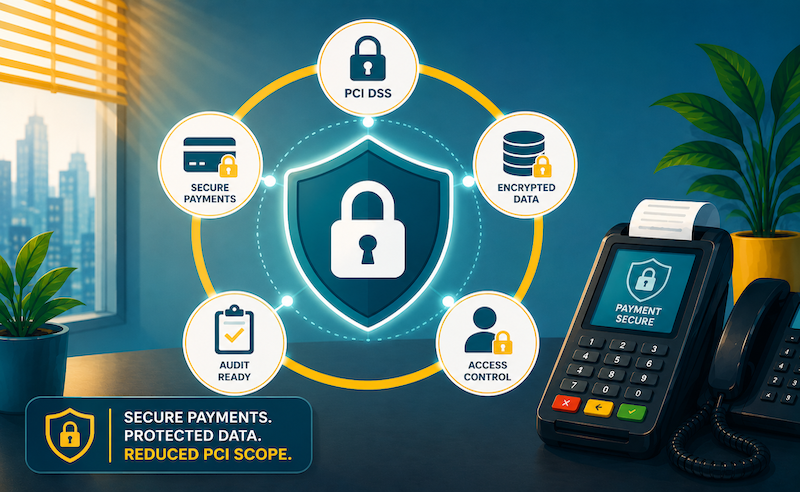
This is where scope reduction becomes a workflow issue, not just a security issue. Tokenization, secure payment links, and controlled capture methods matter because they reduce who can encounter the data and where it can live. PCI SSC has specifically noted that tokenization can reduce the scope of the cardholder data environment and the effort required for PCI DSS assessments. Encryption alone is not enough if the organization still stores, processes, transmits, or can access the underlying data.
The Chargent approach to secure payment collection
Chargent addresses this with workflows designed to limit staff exposure. With Payment Request, sales or service teams can send instant, secure payment links by email so the customer enters payment information directly into a secure flow instead of reading card details to an employee. With Payment Console, call center and support teams can collect payments through a more controlled experience that reduces direct exposure to sensitive data while helping agents resolve cases more quickly.
PCI scope is a workflow issue, not just a compliance issue
The strategic takeaway is straightforward: reducing PCI scope starts with reducing unnecessary exposure. If staff are still handling raw card data through paper forms, unsecured email, or improvised phone workflows, the business is carrying more risk than it needs to. Organizations that redesign payment collection around secure customer input, instead of employee handling, strengthen security, simplify compliance, and create a payment operation that can scale with more confidence.
Achieving PCI compliance is priority number one in the ongoing effort to protect your customers and your business. We can help you get there. Contact us today to learn how.
FAQ
What is PCI scope in payment processing?
PCI scope refers to the people, systems, devices, and processes that store, process, or transmit cardholder data. The more places that sensitive payment information appears, the larger your PCI compliance scope becomes.
How can businesses reduce PCI scope?
Businesses can reduce PCI scope by limiting employee access to raw cardholder data, removing insecure payment collection methods, and using secure workflows such as payment links and protected payment entry tools.
Why is it risky for employees to see or handle credit card numbers?
When employees handle raw card data, the business increases its exposure to security risks and may expand the number of systems and processes that fall under PCI compliance requirements.
Are emailed credit card authorization forms PCI compliant?
Emailing credit card information can create serious security and compliance risks, especially when raw cardholder data is shared through unsecured channels. Safer payment collection methods are generally recommended to reduce exposure.
How do secure payment links improve payment security?
Secure payment links improve payment security by allowing customers to enter their payment information directly into a protected payment page instead of sharing card details with employees over email or phone.
Can payment links help reduce PCI scope?
Yes. Payment links can help reduce PCI scope by keeping employees away from raw cardholder data and reducing the number of internal systems and workflows that touch sensitive payment information.
What is a secure payment console?
A secure payment console is a tool that helps call center or support teams collect payments in a more controlled and secure way, reducing reliance on risky manual processes.
How does a secure payment console help call centers?
A secure payment console can help call centers collect payments faster while lowering employee exposure to sensitive card data and supporting a more secure customer payment experience.
Why is reducing PCI scope important?
Reducing PCI scope is important because it can lower security risk, simplify compliance efforts, and make payment operations easier to manage as a business grows.
What is the safest way to collect customer payment information?
The safest approach is usually one that minimizes employee exposure to raw payment data and directs customers into a secure payment workflow, such as a protected payment page or secure payment request link.
Sources
- PCI Security Standards Council, FAQ 1069, confirming PCI DSS applies to paper records containing PAN:
https://www.pcisecuritystandards.org/faq/articles/Frequently_Asked_Question/does-pci-dss-apply-to-paper-with-cardholder-data-for-example-receipts-reports-etc/ - PCI Security Standards Council, FAQ 1085, stating unencrypted PAN must not be sent via email, SMS, chat, or similar messaging technologies:
https://www.pcisecuritystandards.org/faq/articles/Frequently_Asked_Question/can-unencrypted-pans-be-sent-over-e-mail-instant-messaging-sms-or-chat/ - PCI Security Standards Council, FAQ 1157, on what merchants should do when cardholder data is received through an unintended channel:
https://www.pcisecuritystandards.org/faq/articles/Frequently_Asked_Question/what-should-a-merchant-do-if-cardholder-data-is-accidentally-received-via-an-unintended-channel/ - PCI Security Standards Council, FAQ 1086, noting encryption alone does not make cardholder data out of scope for PCI DSS:
https://www.pcisecuritystandards.org/faq/articles/Frequently_Asked_Question/how-does-encrypted-cardholder-data-impact-pci-dss-scope/ - PCI Security Standards Council, Protecting Telephone-Based Payment Card Data, on how telephone payment collection affects PCI scope and how digital payment-page links can reduce exposure:
https://www.pcisecuritystandards.org/documents/Protecting_Telephone_Based_Payment_Card_Data_v3-0_nov_2018.pdf - PCI Security Standards Council, tokenization guidance, noting tokenization can reduce PCI scope and PCI DSS assessment effort:
https://www.pcisecuritystandards.org/documents/Tokenization_Guidelines_Info_Supplement.pdf - IBM, Cost of a Data Breach 2024: Financial Industry, on average global breach cost, financial-industry breach cost, and human error:
https://www.ibm.com/think/insights/cost-of-a-data-breach-2024-financial-industry - Verizon, 2025 Data Breach Investigations Report Executive Summary, on the human element being involved in roughly 60% of breaches:
https://www.verizon.com/business/resources/reports/2025-dbir-executive-summary.pdf